Kids internalize that they’re bad at school insanely early — often from Kindergarten to second grade — and that judgement causes them to disengage. They protect themselves from the negative feeling of trying and failing repeatedly, of being judged, by putting in less effort and disconnecting from the learning process.
I was shocked the first time I encountered this as a TA in undergrad. I was working with a student on her statistics, who would simply refuse to tell me what she thought. When I finally gave in and told her the answer, she’d say, “Oh, that’s what I thought!” I was astounded. Later I realized it’s common: young students afraid to mark themselves as “stupid” by engaging and failing, so they don’t try at all.
In contrast, I was talking with a high schooler playing Fortnite who was killed quickly in a round — he failed. The team huddled and talked about how to do better the next round. Rather than being discouraged, he encouraged his teammates to stop avoiding fights, because then they’d never improve. That’s impressive metacognition for someone who’d just “failed.”
Look at games as a whole and the pattern is consistent: roughly 80% of gameplay is failure. And yet, the people engaged in that activity are not shrinking back. They are leaning further in.
Two feedback systems
In school, students are given mostly summative assessments to prove their learning. Quizzes, tests, homework. Feedback is delayed while the teacher grades, and even when it’s auto-graded, it’s rarely applied to improve learning. Grades stand as a judgement, not a learning tool. And students realize this. That’s why they start to hate school.
Games are set up with an entirely different feedback system. Feedback is immediate, and it’s always actionable. It can be used to immediately improve on the next iteration. The last failure doesn’t matter — it’s not an “F” weighing down a grade for the rest of the semester — it’s just part of the iterative process of learning and improving.
You can see this quickly if you compare the result of a quiz with a rhythm game. We all know how a quiz works. If you haven’t played a rhythm game, here’s how it works: you hear when you’re off, you get visual feedback, and you can literally immediately apply it and improve. The critical thing is that you can mess up deeply, then get perfectly back on track, and finish with a beautiful run.
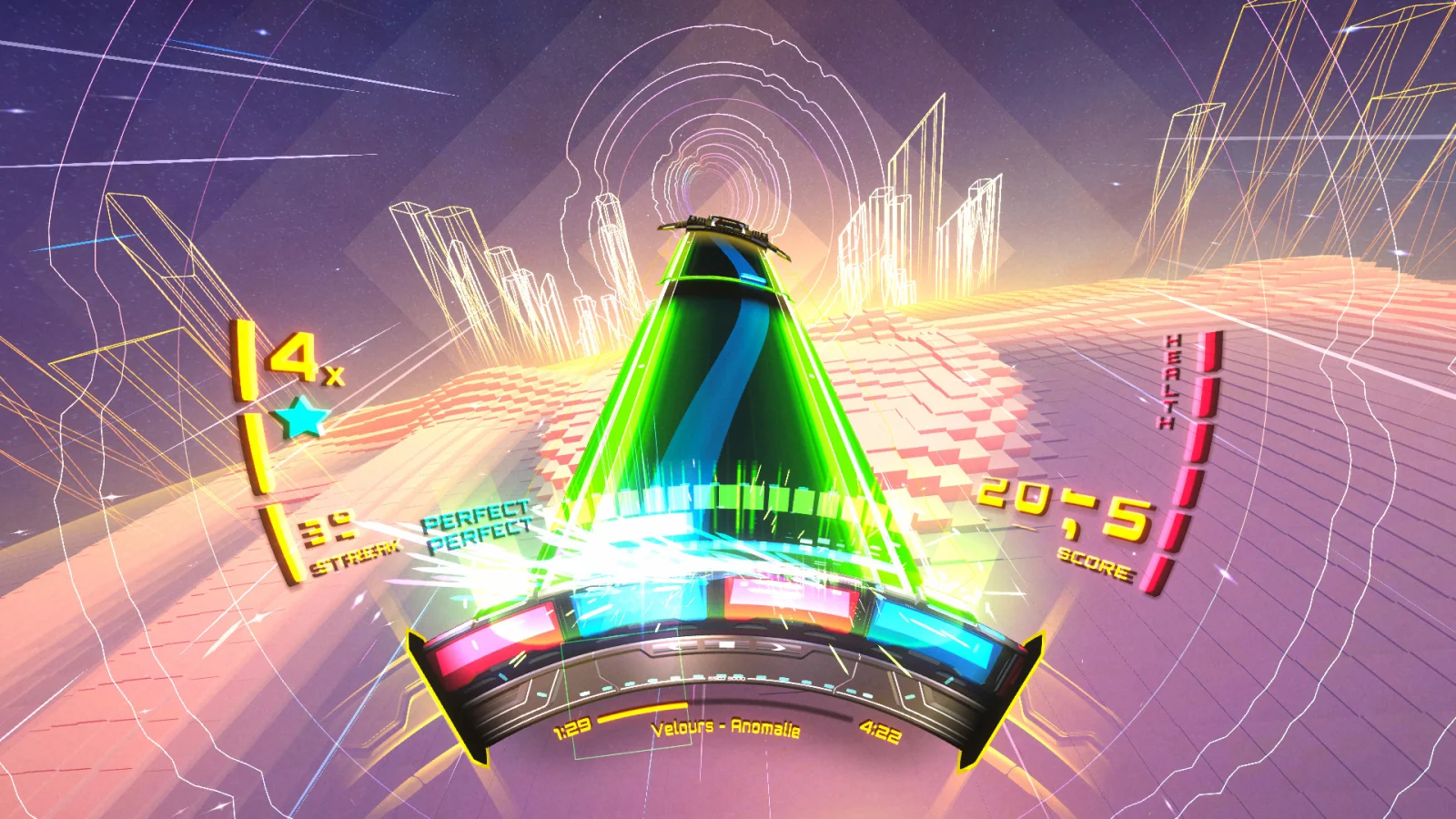
I wish we could say the same about learning feedback systems.
Adversarial by design
Education systems have unfortunately become adversarial for a lot of students. As learning designers, we know we want students in a place where they aren’t afraid to really learn — to experiment, to fail, to improve. But it’s a natural consequence of our grading systems that students aren’t in that place. The system is doing what its design tells it to do.
We’ve been able to use games as a way to break through that fear. To give students a safe place where they can do deeper, experimental learning without the fear of judgement around having failed. And we’ve seen results: students increasing their STEM identity and self-efficacy. I remember the end of one pilot test, where a student who the teacher told us barely ever spoke in class — and was several grades behind — paused on the way out the door to tell us how smart the game made her feel.
What we’re actually trying to do
I’d love to have the power to redesign our broader learning systems and grades so that they give students the opportunity to be more exploratory, to be punished less for failure, to be more open and joyful.
But with the system as it is today, I’m mostly relieved we can use games as an “in.” An opportunity to give students a break from the adversarial threats they feel in their normal learning systems. To lower that barrier so they can experience learning without that threat. And hopefully, to start changing the culture of learning toward one where they can flourish without fear.