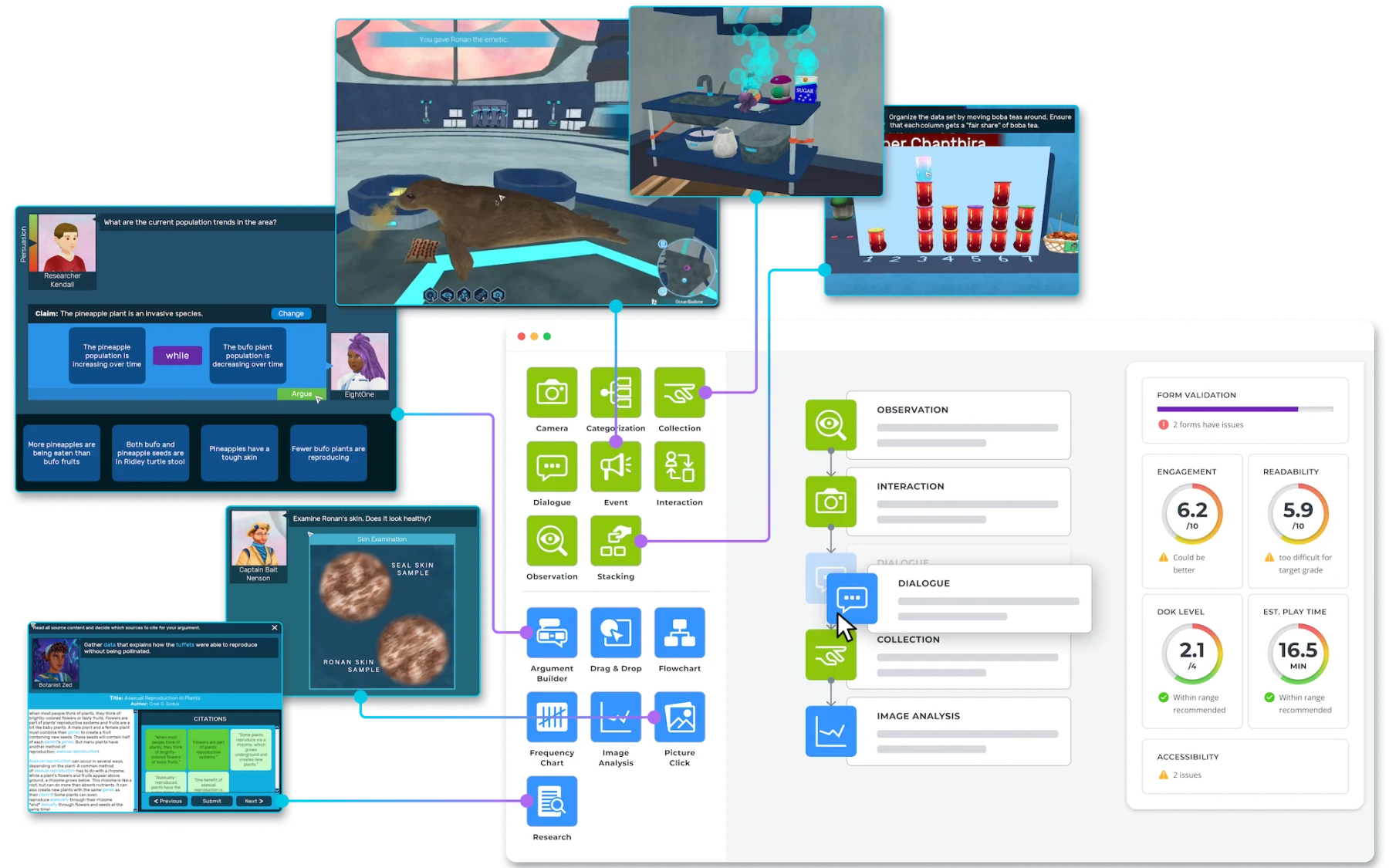
Three steps, from scenario to publish.
What used to take a full dev team — Game developers, 3D artists, UX designers — collapses into something one instructional designer can do. Every step follows the Tyto Learning Framework, designed for research-based best practices.
Ideate.
Define the scenario, and the setting it lives in.
Start with the real-world question learners will investigate, then choose the map and setting that brings it to life. Tyto begins from the scenario, not the textbook chapter, which brings meaning and purpose to the learning.
Learning Flow.
Lay out the steps of guided inquiry.
Sequence the steps of the learning — setting the problem, ways to investigate and gather evidence, build an argument, reflect. The framework gives you the tooling; you define the learner’s process.
Activate Tasks.
Build each step using research-based mechanics.
Customize your content with our library of mechanics — dialogue, argumentation, interactions, modeling — each designed and tested to drive learning outcomes. Drag-and-drop, no code, no waiting on a dev team. You're not inventing from scratch, you're using a validated library.
A practiced creator builds a complete learning experience in around ten hours — a working day or two.
That's in-platform build time. Pedagogical planning and curriculum work sit upstream of this — the same way they would for any serious course-design effort.
"I so love the new dialogue builder. Love it. Love it. Love it."
See what gets produced for the learners.
The most important part is what learners experience. See it in action — four real-classroom videos across math, science, careers, and workplace safety.
The Tyto Learning Framework means you're not building from a blank canvas.
Games made in Tyto follow proven instructional design patterns — concrete scenarios, productive struggle, evidence-based reasoning — even when the person at the keyboard isn't a learning scientist. Rigor isn't bolted on; it's the floor.